Toshokan Sensou
Plot Summary and Review by Niz Biz
Toshokan Sensou - Plot Summary
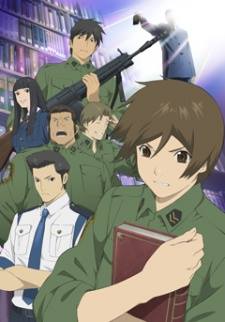
In the near future in Japan, the Media Enhancement Law has been forced upon the population censoring all books and media. To counter this, the Library Defense Force was created. To protect themselves against the Media Enhancement Law Commission, all major libraries are fully equipped with a military Task Force, who take it upon themselves to protect the books and freedom of media of the people. Toshokan Sensou tells the story of Iku Kasahara, the first woman to join the Library Task Force, along with her fellow soldiers as they protect various special books and artifacts from the oppression of the Media Enhancement Law Commission. A love story, war story, and comedy all rolled into one.
Toshokan Sensou - Review
Censorship can go a long way to keeping the stuff we enjoy inoffensive and safe. But how far can it go? Will it go too far? Toshokan Sensou, or Library Wars, explores this topic as the Japanese government is at war with the local government. Or the Media Enhancement Law Commission (Media Betterment Committee-based on the manga) versus the Library Defense Force.
Corporal Iku Kasahara, the main character, is a well develop and an easy-to-relate-to character. Unlike most anime where the main characters have some aspects that make them more notable; Iku comes off as an average person, who’s rather simple-minded, making her character relatable and simply lovable. Her interactions with the other characters in the series are not too overly exaggerated and flow more naturally; a trait that is uncommon in anime.
The other characters that are more prominent with the plot and interact with her directly are her superior officers (Sergeant First Class Atsushi Dojo, Sergeant First Class Mikihisa Komaki and Major Ryusuke Genda) and fellow officer (Corporal Hikaru Tezuka) and her roommate (Librarian Asako Shibisaki or Asako Shibizaki as spelled in the manga).
The most interesting and watched-over interactions are between Iku and Atsushi. Their relationship between one another is that of a superior officer and a subordinate...or is it? Throughout the series, the romance between the two becomes prominent as is their ways of evading the fact that they like each other. Their moments of romance is very rare which makes those moments adorable. Most of their interactions in both the anime and manga are where the two are often seen bickering with one another. Their nonstop bickering is amusing to viewers and the characters in the anime.
Another interesting aspect about Iku and Atsushi’s relationship is that the reason Iku joined the Library Defense Force is because of a man she met when she was a senior in high school. The man she met was a member of the Defense Force and had helped her when she ran into trouble with the MBC (Media Betterment Committee). Only thing is that she does not remember the face of this man. Through the series, she refers to this man as her “prince”, the man she fell in love with. She went on blindly not knowing who her prince is and even comparing him to Atsushi. Whenever Iku mentions her prince around Atsushi, he gets uncomfortable about it and calls her prince an idiot and irresponsible. Which describes him when he first enlisted in the Library Defense Force. Making the connections, yet? :3
One subject that I believe is explored in this anime and one that I find very interesting is the idea of whether or not violent media influences violent reactions. This cliché of violent material igniting violent reactions has been around for a while. It is also because of this notion that the Library often finds itself attacked by civilians who support the MBC. Often times than not, the Library also finds itself in situations where the media- such as T.V. broadcasts stations, newspapers and magazines- oppose the Library. These incidents introduce Corporal Hikaru Tezuka’s older brother, Satoshi.
Satoshi is a mix of an antagonist and a protagonist. He’s the type of character who will do whatever he can to get his main objective. He runs a committee that believes that in order to fight the government, you have to join it. Rather than fight for now, fight for the future. Which, in all sense, is a good reproach, but- and I’m quoting Iku’s take on the matter- what can we do for the people now is fight the government for our freedom to read what we enjoy.
The anime in an overall sense is really good and you can’t help but be engrossed in what is going on. The manga has an even more extensive view of what the anime is trying to portray. Only drawback is that there is only 13 episodes in the anime. 12 of them follow the story and the other is a special about an incident that includes Sergeant First Class Mikihisa Komaki.
After finishing the anime, I couldn’t help but watch the movie that accompanied it. The movie definitely gives a sense a completion to the series rather than the last episode of the anime. And I’ll admit, some tears of happiness were shed. Strongly recommend the movie Toshokan Sensou: Kakumei no Tsubasa or Library War: Wings of Revolution after finishing the anime.
Well, that is my review on Toshokan Sensou. I give this show a 4/5 stars. Definitely recommend if you like the following: military, romance, comedy, realistic fiction.
Later. Niz Biz signing off. V(^.^)V P.S. Usually, Japanese names are the family name (last name) first then given name (first name). I wrote it in given name (first name) then family name (last name), if anyone was curious to know.
Panty and Stocking with Garterbelt
Plot Summary and Review by Remy Anarchy
Panty and Stocking with Garterbelt - Plot Summary
Daten City: A seemingly ordinary place that actually exists between Heaven and Hell. As it so happens, this heavily-populated city has been overrun by a surplus of ghosts and demons. Many humans have died in strange and unusual ways, leading to the creation of more and more ghosts every day. Enter Panty and Stocking, two angels who have been exiled to Daten City for their excessively sinful habits – namely Stocking's need for sweets and Panty's overactive sex drive. Guided by their guardian and caretaker Garterbelt, Panty and Stocking use their heavenly undergarments to send ghosts and the like straight back to Hell.
Panty and Stocking with Garterbelt - Review
Clocking in at thirteen episodes long, this particular anime certainly is not the longest by any means, but that does not stop it from being one of the most original, exciting, and humorous shows ever created. The art style is very much unlike anything Japan had released before its release, having been heavily influenced by Western animation. Even P&S's setting, Daten City, is a pretty obvious reference to Western culture, as it resembles your typical American city. If you want over-the-top action, a ridiculous storyline, and hear A LOT of cursing regardless of whether you're watching the original Japanese or the English dub, then Panty and Stocking with Garterbelt is without a doubt the anime for you.
Each episode is split up, often containing at minimum two shorts that place Panty and Stocking in the craziest of situations. Almost every time the two unlikely heroines are forced to do battle with some giant ghost that has manifested from a dead person's lingering sentiments. Usually the actual battle is over nearly as quickly as it began, but watching Panty and Stocking transform into their angel forms and rip the monsters to shreds is entirely worth it. The art style even changes to something more traditionally Japanese whenever they transform a-la Sailor Moon, albeit their sequences are far more provocative. Both Panty and Stocking know how sexy and badass they are, and they are more than willing to show a little skin to prove it. After the baddie has been beaten and the day is saved, they will often satisfy their respective vices, be it at home or out in the open.
The cast of characters doesn't extend much farther than Panty, Stocking, and their guardian Garterbelt, though there are still some very memorable characters. The main recurring antagonists of the show reveal themselves to be demons which are the very antitheses of the angels: prim, proper, and desiring nothing more than to bring order to the world's chaotic nature. There is also Brief, a red-headed dorky Ghostbuster-wannabe who idiotically falls in love with the sex-obsessed Panty, as well as the girls' pet “dog” Chuck. Whatever kind of strange creature Chuck actually is, sadly he is quite often beaten, smashed, kicked, and even chopped up in nearly every episode he appears in. Chuck also wears a suit incredibly similar to Gir from Invader Zim, which is more than likely yet another nod to Western animation. One of the episodes is even dedicated especially to the little dog-like creature, aptly named 'Chuck to the Future'.
All in all, if you have an incredibly demented and foul sense of humor and have no problem with a more adult-oriented anime, Panty and Stocking with Garterbelt will be right up your alley. I for one frequently cuss like a sailor throughout my daily life, so hearing the girls toss about three dozen F-words in each episode greatly pleased me. P&S is certainly not for children, so unless you're old enough or just have parents who don't give a damn, you probably shouldn't watch it. I cannot recommend it enough for avid lovers of anime, however, and it is one of Gainax's best productions to date.

Inuyasha
Anime Review and Summary written by Augie Futaba.
Inuyasha - Plot Summary
Inuyasha revolves around 15 year old Kagome Higurashi who had previously resided in an old Japanese shrine - built around a sacred tree. (The connection between her world and the futile era) When Kagome discovers an ancient well that had stood almost as long as the tree. Kagome's curiousity gets the best of her, persuading her to make her way down to the bottom of the well when out of no where, through the power of the sacred Shikon no Tama (Jewel of Four Souls), Kagome is transported 500 years back in time to the futile era, at the same well. Kagome saves her dog eared companion Inuyasha, and continues to uncover shards of the Shikon jewel. Romances develop as they meet and greet with some unlikely companions in their attempts to defeat villain spider Naraku and his incarnations. Join Kagome, Inuyasha, Sango, Miroku, Shippo and Kirara in this futile fairy tale!
Inuyasha - Review
Inuyasha was defiantly an experience. I am not a serious heavy fan of Inuyasha but I did buy the box set because it was an anime worth my time. It was defiantly a connecting experience for my boyfriend and I. Inuyasha made me laugh, made me cry, and even route for the bad guy sometimes. The villain Naraku was almost playing the bad boy attractive part, and for some reason, I could see serious similarities between Naraku and Sesshomaru, except for the fact that other then Rin, Sesshomaru cares for no one but himself, while Naraku cares about the destruction of everyone else. Naraku really cares about getting ahead in the world but he goes about it all wrong. He uses his power. (Power being the demons from which he was created)
Now, when it comes to romance, Inuyasha was not the place to go until the very end but you can not simply skip to the very end for feels. Kagome and Inuyasha have an ongoing, heart breaking relationship that could almost be if it weren't for the fact that Inuyasha is still hung over his past lover, Kikyo. To make things worst, Kagome is the reincarnation of Kikyo, and is the spitting image of the deceased precisest. When a correspondent of their enemy Naraku brings Kikyo's dead body back to life, she is astonished to see that all Kikyo was in the end was a lifeless shell with no soul. Kikyo stays alive by corroborating with soul collectors who brought her the souls of other people. Because of Kikyo's existence still going on, Inuyasha refuses to give up his love for her and Kagome continues to be heart broken as he chases after Kikyo.
Enough about Inuyasha and Kagome. Let this paragraph be about the tragic love ballad between Miroku and Sango.. did I say tragic? I meant hilarious. Miroku is the quiet version of Family Guy's Quagmire, in my opinion. His biggest pick up line is, "Would you bare my child?" and you know Sango had feelings for Miroku before he had feelings for her. Every time he would make a move on a beautiful woman he would get a smack, although Miroku showed his affection for Sango through his obsession with her butt, which was exacerbated by their close quarters when travelling together along with the rest of the gang. Later, Sango struggles with believing that Miroku's feelings are pure. I was really happy when Miroku and Sango agreed to marry because their relationship is really pure deep down and I care a lot about their relationship developing and growing. I'm excited to see what happens in Inuyasha The Final Act.
I rate this anime a 5/5, because it has a very wide range of every genre and all of the characters are very developed.

B Gata H Kei: Yamadas First Time
Plot Summary and Review by Augie Futaba
B Gata H Kei: Yamadas First Time - Plot Summary
B Gata H Kei: Yamadas First Time is about 15 year old, too fancy for a first name, Yamada, who goes on a long embark in her high school to find the perfect ‘cherry boy’- the virgin she will bestow with the privilege of being her first sexual partner out of her goal of 100 within her high school career. In a fateful encounter while on her way to the book store to replace her dictionary, (She had highlighted all the sexual terms) Yamada runs into unknown classmate Takashi Kosuda. During that encounter, Yamada concludes that Kosuda is the man she’s been looking for - her perfect cherry boy. Kosuda is astonished by the fact that the prettiest and most popular girl in school decided to go after him, although her intentions are un-pure, he decides to pursue Yamada anyway.
B Gata H Kei: Yamadas First Time - Review
A grandmother of a friend of mine once told me that I was the kind of girl she would have punched out in high school, simply because I pursue a man sexually. The friend, of course, believed I resemble Yamada. At one time in my life or another, I believed the same of myself. Of course, Yamada has it in her mind that to pursue men sexually means you must have the skills of what I would call a cougar. Her biggest fear is that someone would look at her and know she’s never had sex before, and therefor reject her. That leads us to Kosuda-her perfectly perfect, little virgin cherry boy. As basic as he is, he was untouched and therefor perfect for her. Later the anime takes an unexpected turn, as the soon to be slut of her school falls in love with the most average man she could possibly love. Drum-role, please? “dundundundundudndndudndudnhdcbsdgvcgsxjfbsehngfvysjg” TEKASHI KOSUDA! (Oh look, he’s back!) In my opinion, this anime is so funny, and worth the time watching it. I am looking forward to season 2. I was very surprised to see that in season one, you could see Yamada’s determination to bang Kosuda, and yet you could see that she only wanted to bang him, therefor, she had taken away the entire concept of 100 guys in high school from her brain when she fell in love with Kosuda. Ironically, in season one, Yamada continues to be a virgin. Season two better deliver! I rate this anime 5/5 stars because it’s hilarious and has a wide character development when needed and less when not. It finds a way to make every single episode a laughing fit.

Sailor Moon Crystal (2014-2015)
Plot Summary and Review byMokie Tsukino.
Sailor Moon Crystal - Plot Summary
The plot follows an absent-minded, friendly 14-year-old girl named Usagi Tsukino, who transforms into a the pretty soldier Sailor Moon. Her goal is to locate her fellow guardians, search for the Moon Princess as well as the Legendary Silver Crystal. “Sailor Moon Crystal” is the 2014 reboot of the popular 90’s franchise of Sailor Moon. This review will be about the remake and comparing it more to the source material, than the classic anime.
Sailor Moon Crystal - Review
Personally, I’m a fan of the Magical Girl genre and Sailor Moon has definitely shaped the way the genre is handled today. We have the magical side-kicks, the transformations, the villains and romance tied together in one package. Sailor Moon Crystal is a tribute to the original manga and certainly lives up to the title. Sailor Moon Crystal focuses more on the romance between Usagi and Mamoru, showing us the tragedy of having to relive the pain of your past in your present life. We’re presented with a menacing Queen Beryl who will stop at nothing to have both Prince Endymion and the power of the Legendary Silver Crystal, as well as her brainwashed generals who are given a past connection to the princess’ guardians. I enjoy the characterization of Sailor Moon guardians and how closely they match the personalities in the manga. We have Ami Mizuno, the shy bookworm; Rei Hino, the cold and distant priestess; Makoto, the scary yet very feminine girl; Minako, the solo fighter, turned leader.
The artstyle of Sailor Moon Crystal tries to follow Naoko’s elegant, flowly artstyle by adding more movement to the hair, giving the girls longer slender legs and over-sized eyes. Sailor Moon Crystal sticks to the standard shoujo art style. The soundtrack only adds tothe whimsical feel by incorporating an orchestra, but maintains a modern feel by adding in electric guitars for the fight sequences as well as part of the transformation. It also experiments with a full CGI 3d transformation sequence whenever the girls change into their Sailor counterpart. For the fight sequences, Sailor Moon Crystal decided to ditch the stock animation and shows the magical attacks in real time! Also Tuxedo Mask’s character offers a good support, while not taking too much spotlight from a dumpling haired heroine.
While I absolutely love, love, love this incarnation of Sailor Moon, I have to agree with that with the Dark Kingdom arc, it felt rushed, there was enough time to develop Sailor Moon’s teammates. At the same time, I do understand that this version of Sailor Moon is following the manga arc from arc. I also am not a fan of the CGI transformations, but after watching the series, I can say I’ve adjusted.
The biggest flaw of the series would be the occasional art flubs. Fortunately they’re being fixed in the blue ray versions. For the first series, my score would be.
Art – A
Story – B
Characters – B
Fights – A
Sound Track – A
Animation – D
Overall, B.
I would recommend this anime to Sailor Moon fans who are either new to the fandom or familiar with the manga. If you’ve only watched the classic anime, you may have a difficulty adjusting because there are a number of aspects that are different. However, at the same time, the anime was designed for older Sailor Moon fans to offer exposure to the original work (kind of like Full Metal Alchemist: Brotherhood). If you’re not offended about murder/suicides, kidnappings, brainwashing, romance, the use of prayer to overcome darkness and you’ve guessed it, more murder, then I recommend this series to you. I’m super excited that the second half of Season 1, The Black Moon Arc, has already started airing, but that’s for another review. Until later, I’m Mokie Tsukino xoxo

